
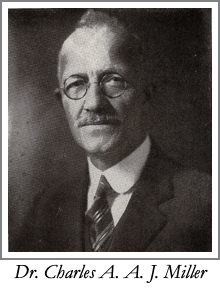
On Sunday, May 1, 1898, the Evangelical Lutheran Church of the Redeemer had its humble origins in the home of Dr. and Mrs. Charles A. A. J. Miller, on Vermont Avenue, where also the Sunday School had been called into existence with an enrollment of twenty-three pupils on February 13, 1898. Both Sunday School and Church under the nursing care of Pastor E. F. Haertel and the founders grew like average from month to month, and at the end of the twenty-second month, December 17, 1899, they walked from their temporary home to the new church edifice, just opposite, to celebrate its dedication. Martini Church in South Baltimore gladly permitted their English Pastor to serve the new Irvington mission, and contributed $500.00 for the new church building and released several members. From friends in our other Lutheran congregations, donations in the amount of $900.00 were received.
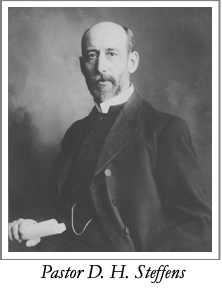
With the new church building, the congregation supposed that there would be speedy progress. However, trials were not long in coming. Pastor Haertel accepted a call to Chicago and left two weeks before the church dedication. Meanwhile, local pastors supplied the pulpit and occasionally a lay reader would serve. When Pastor D. H. Steffens accepted the call as English Pastor of Martini, he also served Redeemer and Bethany till the installation of Rev. Walter L. Moll as resident pastor on September 15, 1900. After several years of service, Pastor Moll resigned to do graduate work at the Johns Hopkins University and later on accepted a professorship of Greek and English at Concordia College, Fort Wayne, Indiana.
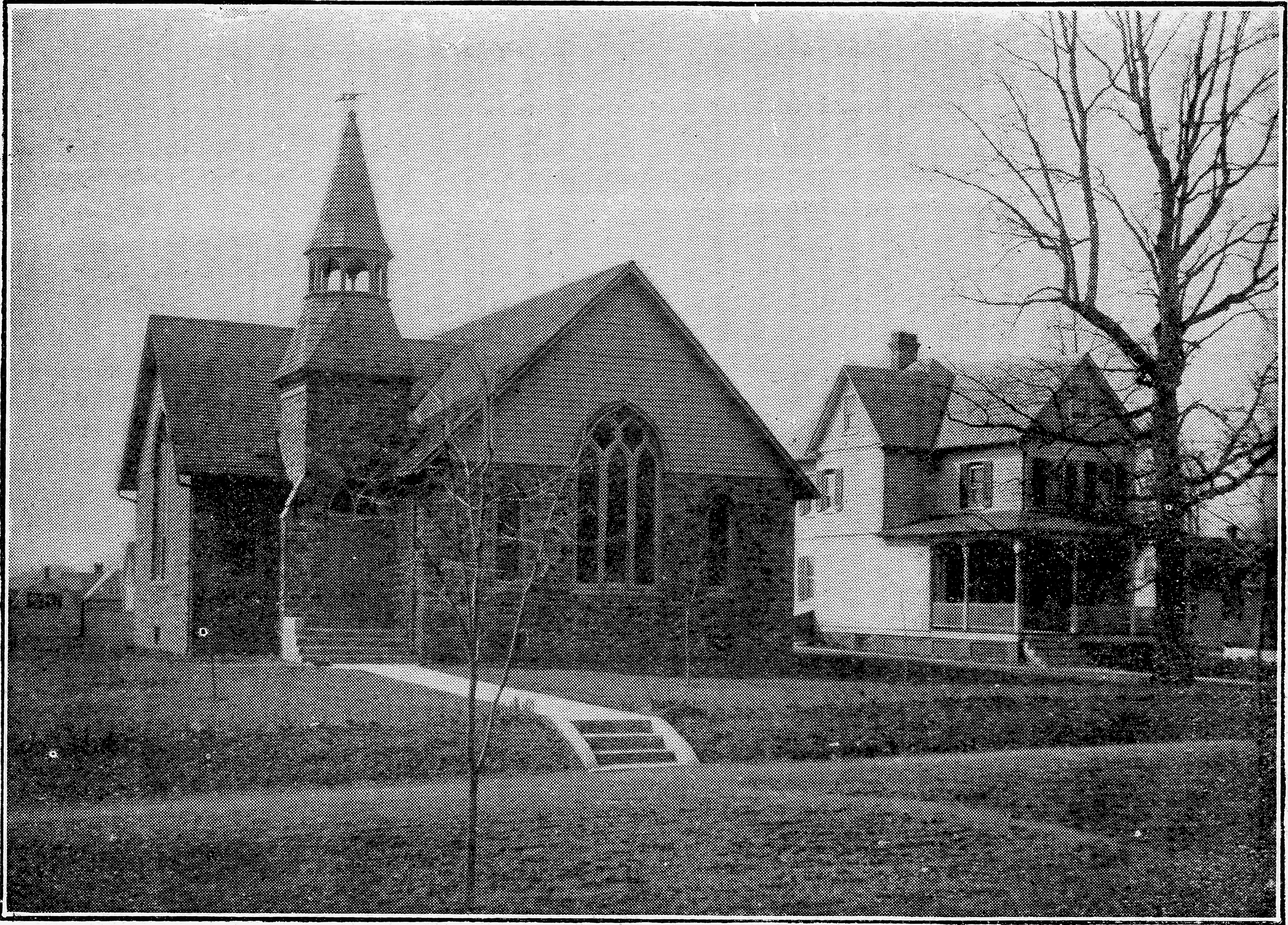
Due to the scarcity of available men, competent to take charge of English congregations, frequent changes in the pastorate were bound to occur. Redeemer in its early days proved to be a training ground for giving pastors experience in office. Pastor E. C. Fackler became Pastor Moll’s successor, began his pastorate on March 6, 1904, and preached his farewell sermon December 17, 1910. During his incumbency both Redeemer and Bethany became thoroughly grounded in Lutheran doctrine and practice. He did the ploughing and sowing and later pastors the reaping. The parsonage was built and dedicated January 19, 1905, and the congregation’s tenth anniversary was elaborately celebrated in 1908. Before Pastor Fackler’s leaving, a call was sent to Pastor E. G. Steger, of Oakmont, Pennsylvania, which he accepted.
He faithfully shepherded Redeemer and Bethany from January 1911 until March 1912. His was a brief ministry, but there was steady growth. Cross Street Mission (now Messiah Lutheran Church) was acquired, accepted by the English Synod’s Mission Board, which subsidized it and had it and Bethany served by one pastor. Redeemer separated from Bethany June 8, 1911, and now, self-supporting, had a full time pastor. However, in the following March 1912 Pastor Steger announced to his congregation that he felt constrained to give up the ministry to enter another profession, his heart’s desire from early youth. Redeemer accepted his resignation.
On June 23, 1912, Pastor William C. Burhop of Kansas City succeeded to the pastorate of Redeemer. He set to work at once, and by his sermons, his sympathy, his affability, and his great concern for the spiritual welfare of his parishioners, he gained the love and confidence of both young and old. His absorbing interest was the indoctrination of the youth. Therefore, he quickly espoused the Church Hall movement, already begun, gave it cordial support, and December 7, 1913, the Hall was dedicated. The congregation grew in knowledge, faith, and charity, and also the pastor, but his reputation also grew. Calls came to him from New York in 1914, from Michigan in 1916, both of which he returned to the senders. The next call to a professorship of English at Concordia College, Fort Wayne, Indiana, came in 1917. It was the subject for debate and discussion at many long meetings of the congregation. The congregation at last consented to hear a committee of Baltimore pastors plead the cause of Concordia College and its great need of excellent professors, and thereafter decided to support whatever conclusion Pastor Burhop reached. When his decision came that he was conscience bound to accept the professorship, Redeemer gave him a peaceful release. He bade farewell to his parishioners on October 7, 1917.
Pastor Eirich was requested to act as vacancy pastor and congregation advisor. After three months of calling, Pastor H. Engelken was the final choice of the congregation. He accepted the call and his installation took place on February 10, 1918. He begun his work when World War I excitement had taken hold of the young and the old, but he wisely steered the congregation. Our 1923 Renovation project was not forgotten. A canvass, begun to swell this fund, ending in adding $1,700, raising the total to $4,098. Pastor Engelken, in 1921, informed the congregation that he had received a call from New York. Neither he nor his congregation was unanimously convinced of its compelling acceptance, and so it was returned. However, fifteen months later, in 1922, St. Stephen’s of New York, a large congregation with a flourishing school, sent an appealing call to our pastor, which, when he was convinced that he must heed it, he accepted; and the congregation granted him a peaceful release. He preached his farewell sermon October 29, 1922.
Pastor Eirich was again called upon to serve as interim pastor and counselor. After several vain attempts at calling, Pastor Eirich’s name was added to the list of candidates. He quickly became the congregation’s choice. After days of prayer and deliberation he accepted the call and asked not to be installed before the completion of the Renovation project. He and his family moved into the parsonage as soon as some repairs and improvements had been made. He then, was able to work more effectively. The Altar and Organ Guild and the Men’s Club were organized. At vestry and congregational meetings plans for enlarging and renovating the church and acquiring a pipe organ were presented and approved. Contracts were given out and by June the work of renovation was completed. The organ, while ready, had not yet been set up. The Rededication of the Church, the Twenty-Fifth Anniversary of the congregation, and the Pastor’s installation were appropriately observed from June 3-6, 1923. On July 22 the new organ was dedicated. The congregation also honored their pastor at his Golden Jubilee in the ministry and his Golden Wedding anniversary. Later, sickness, failing eyesight, and the loss of his beloved wife, slowedup his ministrations. When he found himself unable to fill his charge satisfactorily, he personally tendered his resignation at the congregational meeting of August 4, 1927, to take effect on November 1.
The congregation’s choice as successor to Pastor Eirich was Professor O. W. Kreinheder, President of Concordia College, Conover, North Carolina. The Pastor with the help of the Vestry and the cooperation of his church membership proceeded to carry out a ten-point program that had been adopted. He overestimated his powers of endurance and in December 1928, suffered a severe nervous breakdown. Pastor Mensing, our Lutheran City Missionary, living at 113 S. Augusta Avenue, was requested to take charge of church services and other pastoral duties. Thus relief from the cares of office, excellent medical service, and efficient nursing gradually brought about complete recovery and ability to resume work, which was begun in April, 1929. The Walther Guild was reorganized and the Concordia League for young men and women was established. The news of Pastor Eirich’s death and a destructive fire in the basement and upper floor of the Church Hall were trying ordeals. Rebuilding and enlarging required nine months of hard work. Rededication services for the Church Hall were held April 6, 1930.
Scarcely had all church activities been successfully renewed when there came the long depression period of 1933-1939, which drastically affected industry and business and hampered church and charity projects. But despite depression and recession our church, synodical, and charitable endeavors moved on with efficiency. Plans for another neighborhood Canvass, and total debt liquidation were inaugurated. The Centennial of our Saxon Founding Father’s arrival in this country was adequately celebrated. A generous Thanks-offering was transmitted to Synod’s treasury, and 150 copies of the new Lutheran Hymnal were bought.
World War II began in 1939 and struck our country in 1941, and during its course forty boys and one young lady from Redeemer entered the various branches of the United States Armed Forces. Pastor and congregation loyally supported the government and gave cheerful assistance in all safety measures against fire and possible bombing. Contributions for the management of the various Service Centers and our own in St. Paul’s Parish Hall were freely given. Pastor and people kept in touch with fellow members enlisted in the armed forces by diligent correspondence. All the regular church services were faithfully continued, often to the exhaustion of the Pastor. In the second year of the War, at the July 2nd congregational meeting, he was compelled to announced that he had to undergo a serious operation which would disable him for 2 months. The Vestry was then authorized to make all necessary arrangements to have his pulpit filled and other spiritual needs of the parishioners cared for. This was promptly done, and the Pastor was relieved of a part of his understandable anxiety. He entered Bon Secours Hospital, his operation was successful, and permission was given for his return home in the last week of July. For several days he enjoyed the loving care of his family, but a sudden heart stroke caused his death on July 31, 1942. After a solemn, impressive funeral service at church, with Pastor J. George Spilman, President of the Southeastern District of our Synod in the pulpit, Pastor Kreinheder’s earthly remains were laid to rest in August, 1942.
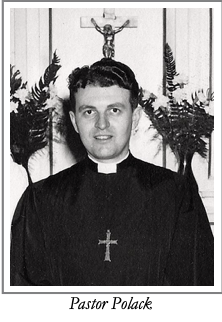
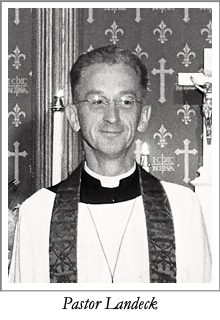
The Rev. W. G. Polack, Jr. of St. Louis, Missouri, serving as Pastor of Bethany Lutheran Church in Violetville, was given the call to fill Redeemer’s vacancy. President Howard Manger reported that he had received a letter of acceptance from Pastor W. G. Polack, Jr., and that his installation would take place November 22, 1942. Pastor Polack’s tenure began with the remaining war years. Redeemer continued its support of its service personnel and shared the responsibility of ministering to service people in our area. During these years, the endeavor to remove all debt was continued. The mortgage burning was conducted in the year 1945 and plans were immediately began to renovate and enlarge the church. Redeemer Church was rededicated to the glory and service of God on Sunday December 4, 1949. Shortly thereafter Pastor Polack received and accepted a call to Trinity Church, Stockton, California. The Rev. Leland Hoyer ably served as vacancy until April 23, 1950, the day that the Rev. Robert L. Landeck was installed as Pastor of Redeemer. During the decade beginning in the post war years, Redeemer experienced its greatest growth with God’s blessing as the community grew with the rising economy. The debt incurred for the building of 1949 was liquidated in the spring of 1955. Redeemer then undertook an extension of its services in Christian education by establishing a Lutheran day school. A class in grads 1 and 2 was started in September 1955 with Miss Jean Geipel as teacher. Since these humble beginnings the school added a grade a year. When it had grown to five grades it was served by the staff of Mr. Norman Hoerauf, Miss Joan Lange, and Mrs. Jean Klender. A sixth grade was then added. In anticipation of the growing needs for the Sunday School, Day School, and church organizations, plans were made to expand the facilities. As a result of these plans the church contracted for a $65,000 building program to provide three modern classrooms, a church office, principal and secretary’s office and enlarged and improved heating facilities for the parish hall. The additions to the hall were completed on November 1, 1958. In June 1958, Pastor Landeck received a call from Bethel Lutheran Church, Middleburg Heights, Ohio. Pastor Landeck preached his farewell sermon on August 3, 1958.
The Rev. George A. Loose of Emmanuel Lutheran Church, Baltimore, Maryland served as vacancy pastor until the Rev. Leo M. Richter accepted our call in September 1959. The Rev. Richter came to Redeemer from Redeemer Lutheran Church, Hyattsville, Maryland, where he had served as assistant pastor. Pastor Richter served Redeemer until June of 1967, when he accepted a call as Chaplain in the United States Navy.
Our Day Care Center was instituted in 1967 for children of 3 to 6 years, and has continued to expand to an enrollment of 48 in 1973. At that time the staff consisted of a Director, two teachers, four aides, and a cook. Secretarial and custodial staff is shared with the congregation.
Redeemer was again without a pastor until Rev. Alvin W. Maack accepted our call and was installed on March 10, 1968. Pastor Maack served Redeemer until his sudden death on August 26, 1970. It was Pastor Maack’s dedicated effort of conducting adult confirmation in the confirmand’s homes that brought the first members to Redeemer from the increasing African American population in Irvington, bringing increased racial integration into the congregation. A Child Care Center was instituted in 1967 for pre-school children 3 to 6 years of age. In the Spring of 1969 the congregation decided to close the Day School after a long period of wrestling with the problems of decreasing enrollment, increased subsidy, and bleak projections of the future potential. This was a time of stress due to the fervent desire of many to continue this service of Christian education that took much dedication and effort to establish.
In the interim between Pastor Maack’s death and the arrival of our new pastor, the Rev. Richard D. Brandon, the Rev. Albert E. Bielenberg served as our vacancy pastor. Pastor Brandon came to Redeemer in July, 1971, after his mid-life graduation from Concordia Theological Seminary, Springfield, Illinois. With his guidance, and the leadership of Robert Foerster, the Child Care Center grew and the Congregation developed an increased sense of family. Fellowship meals in conjunction with Advent and Lenten services were begun. In 1977, Pastor Brandon received a call from the Synod’s Board of Missions to serve as a missionary in New Guinea where he had previously served as a lay mission executive. He later served as missionary in West Africa, especially in Ghana.
Pastor John W. Bremer accepted the call to Redeemer and arrived in August of 1977. Pastor Bremer brought a new dimension to the worship at Redeemer by introducing the liturgy of the The Lutheran Book of Worship. On May 1, 1979, Pastor Bremer was the victim of a severe automobile accident which rendered him completely immobile and unable to communicate. In this time of great trauma, the people of Redeemer responded by supporting the Bremer family in prayer and worship. Redeemer was served by supporting clergy during an interval of one year while it was determined that Pastor Bremer would not be able to return to the ministry.
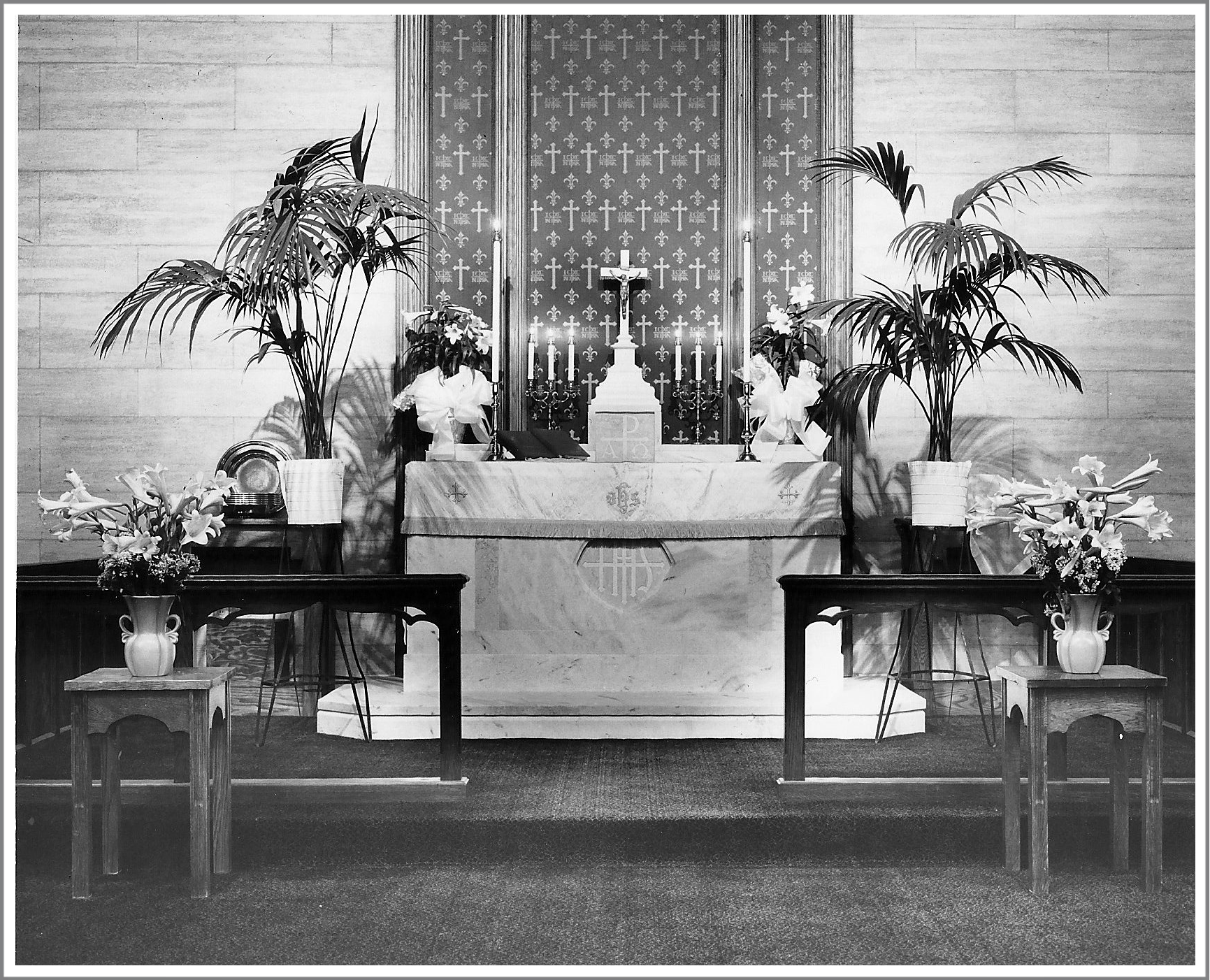
In the Spring of 1980, Pastor Vernon P. Schultheis accepted the call to Redeemer. He worked to strengthen urban ministry to the community of Irvington. The Redeemer Youth Group was re-established and involved many youth from the neighborhood. The constitution and bylaws of Redeemer were rewritten for more effective leadership by giving more authority to the elected boards, and more women began to serve in the organizational structure. Pastor Schultheis emphasized the study of the Word, and a led many Bible Studies. The chancel was refurbished, emphasizing the communion by bringing forward the altar and enlarging the serving area. An artist from Washington, D.C., Mr. Gordon Kray, was commissioned to sculpt the striking crucifix on the reredos. Pastor Schultheis accepted a call to New York City in July of 1987. During the vacancy the congregation was well served by the Rev. Donald McClean as interim pastor.
The Rev. R. Keith Lee was installed as pastor in August, 1988. He became active in the Irvington Community Association. Because the chancel organ was difficult to keep in repair, the congregation purchased a renovated tracker action pipe organ and placed it in the transept. Much of the cost of this instrument was covered by a significant financial gift from Katherine Lemmert, a former member and long time organist at Redeemer. This organ was dedicated on July 9, 1989. In December of 1989 the food co-op was closed due to the changing culture which placed more value on time than on money.
The Rev. Wayne A. Hartz, who was serving Bethany Lutheran Church part time, accepted the contracted position of part-time pastor at Redeemer in January 1994. Redeemer incorporated contemporary style worship with music groups visiting nearly monthly. The transfer of the Child Care Center to RFLC occurred effective January, 1996. Pastor Hartz took a leave of absence in September of 1998 and his contract ended at the end of 1998.
Pastor Paul C. Heins entered into a contract with both Bethany and Redeemer congregations at the end of October 1998 with a renewal through the end of 2000 contracted in March of 1999. Pastor Heins was granted a peaceful release from his call at a special Congregational Assembly held August 4, 2002 and his last day of service in the church was August 11, 2002.
On April 24, 2005, the Rev. Herbert Duberry was installed as Pastor of Redeemer after completing a colloquy program under the Rev. Dr. Robert Mordhorst. In 2008, after a time of division and hardship, Pastor Duberry resigned his call. By this time the RFLC had closed and the church membership decreased to five. The vacancy was filled by local pastors under the leadership of Pastor Elliott Robertson of Martini Lutheran Church. During these years there were many attempts to share the Gospel in the community. There was also times of great hardship. In 2008, a large tree that grew between the church and the parsonage fell, send a large branch into the parlor of the parsonage. By the grace of God it just barely missed destroying the windows of the church. The parsonage was repaired but then in 2011, during a heavy snow storm, the pipes in the parsonage burst. Several churches helped to repair the damage and provide a place for a new pastor to live. In 2010, St. Thomas Evangelical Lutheran Church called a pastor from Concordia Theological Seminary in Fort Wayne, Indiana to serve as a missionary pastor to Redeemer. On November 21, 2010 Roy Axel Coats was ordained and installed at Redeemer on the Feast of the Presentation of Mary. Just before his arrival to Baltimore a family of Liberian refugees started to attend. They became members and their children were baptized. They helped bring other families in as well and by 2014 the membership rose to 40. Pastor Coats also brought with him the Lutheran Service Book and a more traditional ceremonial of conducting the Divine Service and restored several more traditional Lutheran rituals. On August 24, 2014 Pastor Coats was installed as the called pastor at Redeemer.
Redeemer today continues to preach, teach, and confess the apostolic and catholic faith that has been handed down to her. She continues to worship the Most Holy Trinity according to her ancient liturgical forms. Even though the pastors and the congregation change, the true confession and the proper worship of our Lord Jesus Christ remains the same. By the grace of God we will continue to confess and worship in this way until our Lord’s glorious return.
SOLI DEO GLORIA!
 Lutheran Church of the Redeemer